
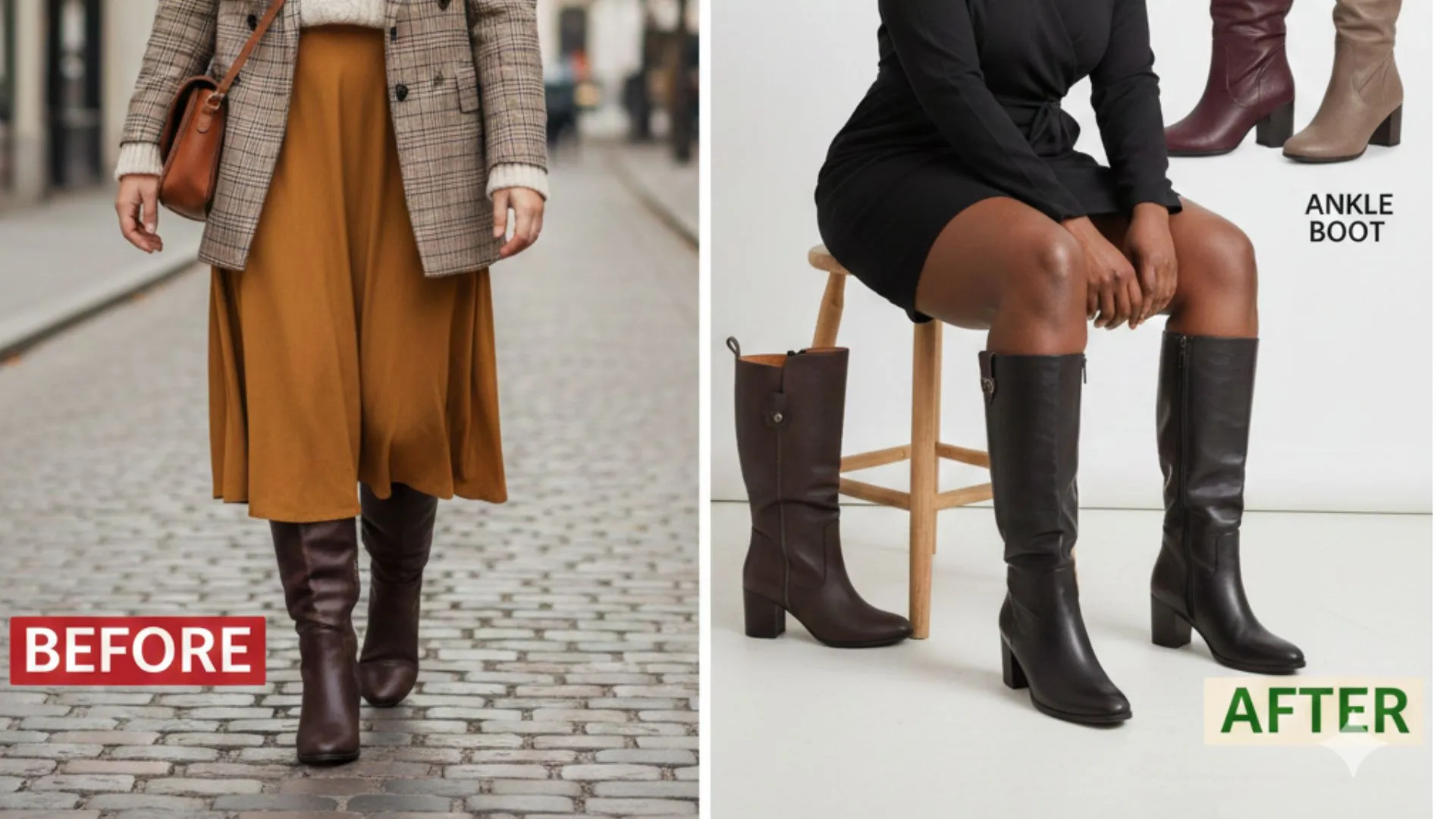
Claim your style! No more squeezed calves. Learn the professional way to find wide calf boots that actually fit your gorgeous curves. Read our 2026 guide.
Picture this: You're scrolling through your favorite online boutique, and there they are—the boots of your dreams. Rich cognac leather, the perfect heel height, a silhouette that screams sophistication.

💕 Plus Size Fashion Questions? Ask Isabella!
Style, outfits, looks, combinations, fashion tips... quick & caring answers.
💕 Top Plus Size Fashion Picks
Handpicked products that fit and flatter curves














You click "add to cart" with trembling fingers, already imagining the compliments you'll receive. Two weeks later, the package arrives. You tear it open, slide your foot in, and then... nothing.
The zipper won't budge past mid-calf. Your excitement deflates like a punctured balloon, replaced by that all-too-familiar mixture of disappointment and frustration.
If this scenario resonates with you, you're far from alone. For years, the fashion industry has operated under the misguided assumption that one calf circumference fits all, leaving countless women with beautifully proportioned calves feeling excluded from one of fall and winter's most essential wardrobe staples.
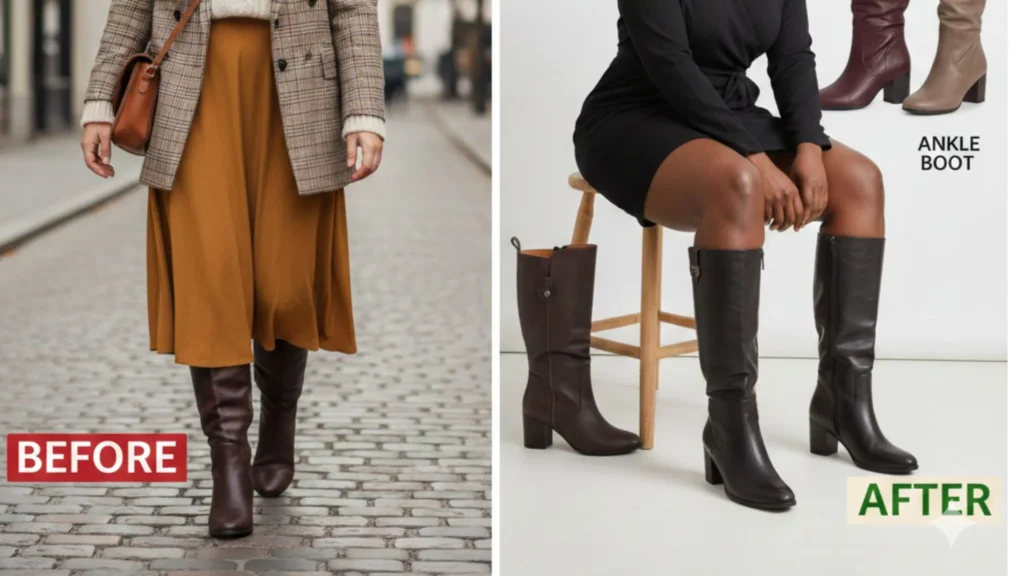
But here's the truth that nobody talks about: athletic calves, muscular calves, and naturally fuller calves are not a sizing problem—they're a measurement opportunity.
The game changes completely when you understand how to measure your calves correctly and interpret those numbers in the context of boot specifications.
This isn't about settling for "what fits." This is about claiming your rightful place in the world of luxury footwear, understanding the technical specifications that ensure a flawless fit, and never again experiencing the heartbreak of boots that refuse to cooperate with your gorgeously proportioned legs.
- Why Wide Calf Boots Deserve Your Attention (And Your Investment)
- The Anatomy of Wide Calf Boots: Understanding the Perfect Fit
- The Professional Measuring Protocol: A Step-by-Step Masterclass
- The Style Advisor's Secret Tip: The Sock and Shaft Strategy
- Decoding Boot Specifications: What the Numbers Really Mean
- The Ultimate Wide Calf Boot Comparison: Your Buying Guide
- Styling Wide Calf Boots: Professional Techniques for Proportion
- How Different Boot Materials Affect Fit
- Troubleshooting Common Wide Calf Boot Fit Issues
- Frequently Asked Questions: Expert Answers
- Your Confidence Manifesto: Claiming Your Space in Fashion
Why Wide Calf Boots Deserve Your Attention (And Your Investment)
The revolution in wide calf boot construction over the past five years has been nothing short of extraordinary.
Where once you might have found a handful of matronly, uninspired options tucked away in the back corners of department stores, today's wide calf boot market rivals—and often exceeds—the style sophistication of standard-width offerings.
Modern wide calf boots incorporate innovative stretch panels, strategic elastic goring, and architectural zipper placements that don't just accommodate fuller calves; they celebrate them.
Premium manufacturers now employ specialized last-making techniques that account for proportional scaling—meaning when the calf circumference increases, so does the ankle width, foot bed proportions, and shaft height in mathematically precise ratios that honor your body's natural geometry.
The Anatomy of Wide Calf Boots: Understanding the Perfect Fit
Before we dive into the measuring process, you need to understand the language of boot construction. These aren't arbitrary numbers—they're the blueprint for your comfort and confidence.
Measuring Calf Circumference for Wide Calf Boots
This is the widest point of your calf, typically located 12-14 inches up from the floor when you're standing naturally. In boot specifications, you'll see this listed as "calf circumference" or simply "calf width."
Standard boots typically range from 13-15 inches, while wide calf boots generally start at 15 inches and can extend to 22 inches or more in extended sizing.
Here's what nobody tells you: The listed calf circumference in boot specifications is the interior measurement of the boot shaft.
Your actual calf measurement needs to be at minimum 0.5 inches smaller than the boot's listed circumference to avoid uncomfortable pulling. Ideally, you want 0.75-1 inch of ease for comfort and longevity of the boot materials.
Shaft Height: The Forgotten Variable
Shaft height measures from the bottom of the heel to the top of the boot opening. This measurement interacts dramatically with your calf placement.
If you have a lower calf peak (the widest point sits closer to your ankle), you might be able to wear boots with a slightly smaller calf circumference if the shaft height is shorter.
Conversely, if your calf peak sits higher, you need to pay careful attention to where the boot's widest point hits your leg.
Most wide calf boots range from 14-18 inches in shaft height, though OTK (over-the-knee) styles can extend to 22-24 inches.
The relationship between shaft height and calf circumference is logarithmic, not linear—a critical distinction when you're shopping.
Boot Opening: Your Entry Point Matters
The boot opening (the circumference at the very top of the boot) becomes particularly crucial in taller styles.
Even if the calf measurement works, a boot opening that's too snug will create that dreaded "muffin top" effect above the boot line.
Look for boot openings that are 1-2 inches larger than the widest part of your calf, especially if you plan to tuck pants into your boots.
The Professional Measuring Protocol: A Step-by-Step Masterclass
Measuring your calf correctly is a skill, not a guessing game. Here's the protocol used by professional boot fitters and custom shoemakers:
What You'll Need
- A flexible measuring tape (fabric or plastic, not metal)
- A full-length mirror
- A friend or a smartphone with a timer for photos
- The tightest pants or leggings you'll wear with boots
- Flat, hard flooring (not carpet)
The Measurement Process
Step 1: Choose Your Foundation
Put on the pants or tights you typically wear with boots. If you favor thick winter tights or skinny jeans, measure over them.
Your calf measurement with clothing is your functional calf circumference—the number you actually need to shop by.
Step 2: Find Your Calf Peak
Stand naturally with your weight evenly distributed. Starting about 8 inches above your ankle bone, wrap the measuring tape around your leg and slowly move it upward in half-inch increments.
You're looking for the absolute widest point—this might be lower than you think. For most people, it sits 12-14 inches from the floor, but athletic builds may peak lower (10-11 inches) while longer-legged individuals might peak higher (15-16 inches).
Step 3: The Critical Measurement
Once you've found your calf peak, wrap the tape measure snugly (but not tight) around your leg. The tape should be parallel to the floor—this is crucial.
A measuring tape that angles even slightly will give you an inaccurate reading. Take this measurement three times and average the results. This is your true calf circumference.
Step 4: Measure Your Calf Peak Location
With the measuring tape at your calf peak, measure straight down to the floor. This is your calf peak height—a specification that's often overlooked but absolutely critical for proper boot fit.
Step 5: Additional Measurements for Perfection
- Ankle circumference: Measure around the narrowest part of your ankle, just above the ankle bone
- Mid-calf measurement: Measure 6-7 inches up from the floor
- Below-knee measurement: If you're considering tall boots, measure 2 inches below your knee cap
Record all these numbers in a note on your phone. These are your personal boot fitting specifications, and they're worth their weight in gold.
The Style Advisor's Secret Tip: The Sock and Shaft Strategy
Here's an insider hack that professional stylists use but rarely share: the differential compression technique. When you're trying on wide calf boots (or ordering online and want to test fit at home), wear a thin trouser sock on one leg and a thick winter sock on the other.
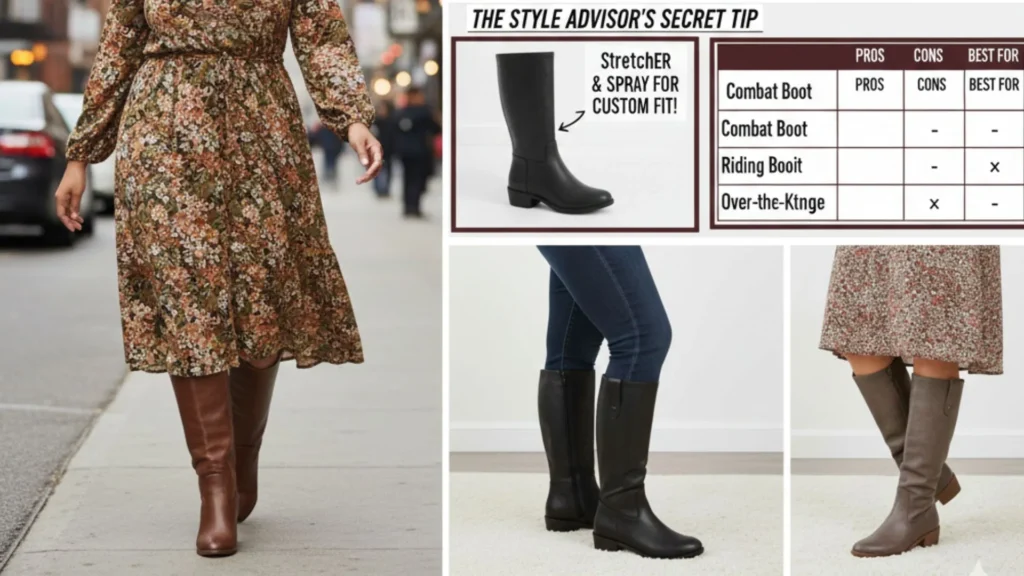
Slide into the boot with each leg and pay attention to how the boot responds. If the boot feels significantly more comfortable with the thick sock, the calf circumference is actually too large for your leg—you're experiencing what's called "negative ease," and the boot shaft will eventually slouch and lose its shape.
If the boot only fits comfortably with the thin sock, it's perfectly sized. If neither sock option feels comfortable, size up.
This technique prevents the common mistake of buying boots with excessive calf room "just to be safe," which leads to boots that don't hold their shape and create unflattering wrinkles around your calf.
Decoding Boot Specifications: What the Numbers Really Mean
When you're shopping for wide calf boots, you'll encounter various specification formats. Here's how to translate them:
Standard Format: "Calf Circumference: 16 inches"
This seems straightforward, but remember—this is the unstretched interior measurement. If the boot contains any stretch materials (look for terms like "stretch panel," "elastic goring," or "stretch fabric"), you can typically add 1-2 inches to this number for your maximum comfortable fit.
Range Format: "Calf Circumference: 15-17 inches"
This indicates the boot has built-in stretch capability. The lower number is the unstretched measurement; the upper number represents the maximum stretch before material stress becomes visible or uncomfortable.
Diagonal Measurement Format: "Calf Measurement: 16 inches (measured diagonally)"
This older measurement format accounts for the natural angle of your calf. To convert this to your horizontal calf measurement, subtract approximately 0.5 inches.
The Ultimate Wide Calf Boot Comparison: Your Buying Guide
After analyzing hundreds of wide calf boot options across multiple price points and style categories, here's your definitive buying guide:
| Boot Style | Calf Circumference | Shaft Height | Pros | Cons | Best For |
|---|---|---|---|---|---|
| Classic Riding Boot (Best Overall) | 16-18 inches | 15-16 inches | Timeless silhouette, pairs with everything from jeans to dresses, premium leather ages beautifully, professional enough for workplace | Requires break-in period, investment piece pricing, limited weather resistance without treatment | Women seeking one versatile pair that works for multiple occasions and seasons |
| Chelsea Boot with Stretch Panel (Best Budget-Friendly) | 15-17 inches | 5-6 inches | Easy on/off with elastic panels, under $100 price point, minimal break-in needed, ankle height works with multiple pant styles | Less leg-lengthening than tall boots, elastic panels can wear out over time, limited formal styling options | Everyday wear, casual weekend styling, those new to wide calf boots wanting to test the waters |
| Over-the-Knee with Adjustable Back | 17-20 inches | 22-24 inches | Dramatic fashion statement, adjustable lacing or straps accommodate multiple calf sizes, trend-forward styling, excellent leg-lengthening effect | Requires confidence to wear, can be challenging with skirts/dresses, may read too "costume-y" for conservative workplaces | Fashion enthusiasts, evening occasions, those with very proportional legs who want maximum impact |
| Wedge Heel Wide Calf Boot | 15.5-17.5 inches | 12-14 inches | Comfortable all-day wear, stable heel provides height without tipping, great for walking, versatile style | Can add visual weight to the leg, wedge silhouette isn't currently trending, fewer luxury options in this category | Women prioritizing comfort, those with foot issues, casual professional environments |
| Premium Stretch Leather Knee-High (Premium Investment) | 16-19 inches with flex | 16-18 inches | Molds to your exact calf shape over time, Italian leather construction, luxury hardware, professional finish | $300+ investment, requires professional care and conditioning, stretch leather can be difficult to size online | Those investing in a signature boot, professional environments, women who will wear them 3+ times weekly |
| Western-Inspired Wide Shaft Boot | 16-18 inches | 13-15 inches | On-trend for current fashion, decorative details add interest, comfortable walking heel, shaft naturally accommodates fuller calves | Very trend-specific (may date quickly), embellishments can overwhelm petite frames, requires confident styling | Fashion-forward casual wear, women comfortable with statement pieces, Western/Southwestern aesthetics |
| Lace-Up Combat Boot with Wide Shaft | 15-18 inches (adjustable) | 8-10 inches | Completely adjustable fit, edgy aesthetic, durable construction, flat sole for all-day wear | Lacing and unlacing is time-consuming, can read too casual for some professional settings, less elegant than sleeker styles | Casual everyday wear, younger demographics, those who prioritize adjustability over streamlined silhouette |
Best Overall: The Classic Riding Boot
For sheer versatility and longevity, a well-constructed riding boot in premium leather with a 16-18 inch calf circumference remains the gold standard.
Look for full-grain leather (not bonded or corrected grain), a stacked leather heel rather than composite, and interior zippered gussets that lie flat against your leg.
Brands like Naturalizer, Trotters, and Comfortview consistently deliver in this category with proper wide calf scaling.
The ideal riding boot should have minimal hardware (keeps the silhouette clean), a shaft height that hits just below your knee cap, and a heel height between 1-1.5 inches for optimal proportion.
The boot should stand upright on its own when not being worn—this indicates quality shaft construction that won't slouch with wear.
Best Budget-Friendly: Stretch Panel Chelsea Boot
For under $100, you can find excellent Chelsea boots with strategically placed stretch panels that accommodate 15-17 inch calves.
The elastic gore at the ankle provides automatic adjustment, while many styles now include a matching stretch panel that runs up the outside of the shaft.
When shopping budget-friendly options, inspect the elastic carefully. It should be thick (at least 1/8 inch wide) and ideally reinforced with internal webbing.
Thin elastic gores stretch out within a season and lose their shape. Also verify that the elastic is sewn—not glued—into the boot construction.
Premium Investment: Stretch Leather Knee-High
If you're ready to invest $300-500 in a pair of boots that will last 5+ seasons, stretch leather knee-highs from brands like Stuart Weitzman, Aquatalia, or Blondo represent the pinnacle of wide calf boot engineering.
These boots use specially tanned leather that contains actual elastic fibers woven into the hide during production—this isn't a stretch panel added later, but rather leather that fundamentally behaves differently than standard cowhide.
The advantage? The boot molds precisely to your calf over the first few wears and maintains that shape indefinitely.
The leather stretches up to 2 inches from its listed circumference without distorting, then returns to its original measurement when removed. This is the technology that allows one boot to fit multiple calf circumferences perfectly.
Styling Wide Calf Boots: Professional Techniques for Proportion
Understanding how to style wide calf boots transforms them from merely functional to absolutely fabulous. Here's what the professionals know:
The Inseam Principle
Your boot shaft height should mathematically relate to your pant inseam for optimal proportion. If you typically wear a 32-inch inseam, aim for boots with a 14-16 inch shaft.
For a 28-inch inseam, keep shafts at 12-14 inches. For taller women with 34-36 inch inseams, you can embrace 17-18 inch shafts, including OTK styles.
This principle prevents the "cut-off" visual effect where boots appear to truncate the leg line rather than extend it.
The Rise Solution
The "rise" of your pants (where the waistband sits on your torso) dramatically affects how boots integrate with your overall silhouette.
High-rise pants (sitting at natural waist) work beautifully with any boot height because they create a continuous vertical line.
Mid-rise pants (sitting between natural waist and hip bone) pair best with boots that hit just below the knee. Low-rise pants should only be worn with ankle boots or short shaft boots to avoid awkward gaps.
The Tucking Technique
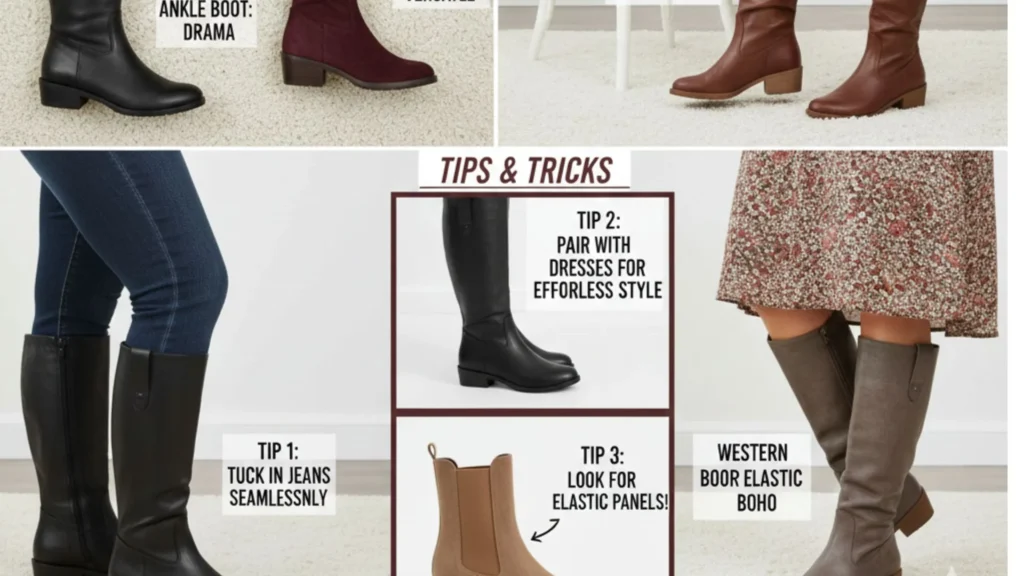
Tucking pants into wide calf boots requires precision. The pant leg fabric should lay flat against your skin with no bunching, then the boot should slide on smoothly over it.
If your pants bunch inside the boot, they're too voluminous in the leg. Look for skinny jeans and leggings with recovery fabric—materials that return to their original shape after stretching—which prevents the saggy-knee syndrome that creates bulk inside boots.
For perfect tucking: fold your pant hem under once (creating a clean finished edge), pull the pants taut against your leg, then zip the boot. The pant fabric should be invisible once the boot is on.
The Bootcut Illusion
Wearing bootcut or slightly flared pants over wide calf boots creates a phenomenally lengthening effect. The key is ensuring your pants have a 34-inch inseam minimum (regardless of your height) and the flare begins exactly at your knee.
When the pant leg drapes over the boot shaft, it should cover the boot entirely while walking but reveal a glimpse of the boot shaft when standing still.
How Different Boot Materials Affect Fit
Material composition isn't just about aesthetics—it fundamentally changes how a boot fits your calf:
Full-Grain Leather
Requires a 2-3 week break-in period during which the leather gradually softens and conforms to your calf shape.
Buy these boots snug (your calf measurement plus only 0.5 inches) because they will stretch. After break-in, full-grain leather maintains its shape indefinitely with proper care.
Suede
Stretches more readily than smooth leather but also requires more maintenance. Suede boots should fit perfectly on first wear because they'll give an additional 0.25-0.5 inches during the first month. The nap (raised fibers) can disguise fit issues, so be especially rigorous about measurements.
Synthetic Leather/Polyurethane
Does not stretch or conform. What you try on is what you get forever. This means synthetic boots should have approximately 1 inch of ease from your calf measurement on day one.
The advantage? Zero break-in discomfort. The disadvantage? They can never be professionally stretched if sizing is wrong.
Stretch Fabric Panels
Typically adds 1-2 inches of give to the listed calf circumference. Check whether the stretch runs vertically (accommodates calf circumference) or horizontally (doesn't help with width).
Quality stretch panels rebound after each wear; inferior ones develop permanent stretch and lose support.
Troubleshooting Common Wide Calf Boot Fit Issues
Even with perfect measurements, issues can arise. Here's how professionals address them:
Issue: Gapping at the Ankle
Cause: Your ankle-to-calf ratio differs from the boot's construction.
Solution: Look for boots with adjustable ankle straps or elastic goring at the ankle. Alternatively, install heel grips inside the boot's heel counter to prevent slippage.
Some women successfully use thin neoprene calf sleeves (yes, like for athletic compression) to fill the gap between ankle and calf.
Issue: Boot Shaft Slouching
Cause: Calf circumference is too large for your actual leg, allowing the shaft to fold over.
Solution: Install boot shapers when storing, or consider professional shaft alteration. Many cobblers can take in boot shafts by removing material from the back seam and re-stitching. Cost typically runs $40-60 but extends boot life dramatically.
Issue: Zippers Pulling or Gapping
Cause: The zipper isn't designed to handle the tension from your calf circumference, or the zipper itself is poorly constructed.
Solution: This is almost always a manufacturing defect, not a sizing issue. Higher-quality boots use reinforced zippers with double-pull mechanisms that distribute stress.
If a zipper pulls on a brand-new boot, return it—this will only worsen with wear. Never try to force a zipper; it causes permanent tracking damage.
Issue: Painful Pressure at Calf Peak
Cause: The boot's widest point doesn't align with your calf's widest point.
Solution: This is the calf peak height issue discussed earlier. You need boots with a different shaft height, or boots specifically designed with the maximum circumference positioned higher or lower.
Some brands now offer "athletic calf" versus "standard calf" wide options that account for different calf peak placements.
Frequently Asked Questions: Expert Answers
1. Should I size up in wide calf boots if I'm between sizes?
This depends entirely on your foot length versus calf circumference. If your foot fits perfectly in your true size but your calf is at the maximum listed circumference, look for boots with stretch capabilities rather than sizing up.
Sizing up gives you a boot that's too long in the foot, which causes your heel to slip and ruins your gait. Instead, search for the same style in a wide calf option within your true foot size.
However, if your foot genuinely measures between sizes (for example, you're a 9.5 in athletic shoes but some brands only offer 9 or 10), sizing up makes sense provided the calf circumference still works. Use insole inserts to fine-tune the fit rather than tolerating a too-small boot.
2. Can a cobbler stretch the calf of boots that don't fit?
Yes, but with significant limitations. Full-grain leather boots can typically be stretched 0.25-0.5 inches in circumference through professional stretching.
This process uses specialized boot forms and stretching sprays applied over 24-48 hours. Cost ranges from $30-60.
However, boots with zippers cannot be stretched beyond 0.25 inches because the zipper tape won't expand—stretching the leather beyond what the zipper accommodates causes the zipper to buckle or separate from the boot.
Synthetic materials cannot be stretched at all. And stretching permanently weakens leather, reducing the boot's overall lifespan.
Bottom line: Stretching is a salvage technique for boots that are close but not quite right, not a solution for boots that are significantly too small.
3. How do I know if a boot is "wide calf" versus just a wide shaft?
Genuine wide calf boots are proportionally scaled across all measurements—not just the calf circumference. A true wide calf boot will have:
- Wider ankle opening (typically 10-12 inches vs. 8-10 inches standard)
- Wider foot bed, particularly in the ball and toe box
- Appropriately scaled shaft height (taller women with wider calves typically need taller shafts)
- Heel construction that accounts for a different foot-to-leg angle
A boot that simply has a wide shaft without proportional scaling will fit awkwardly—gapping at the ankle, pulling at the instep, or creating painful pressure points.
Always verify that the brand explicitly calls out "wide calf" rather than just showing a wider-looking shaft in photos.
4. Do I need different calf measurements for different boot heel heights?
Absolutely yes. Heel height changes your calf circumference by altering your foot's angle and your calf muscle engagement. Measure your calf while wearing the heel height you'll typically wear with boots:
- Flat boots (0-0.5 inch heel): Measure while barefoot or in flats
- Medium heel boots (1-2 inch heel): Measure while wearing 2-inch heels
- High heel boots (2.5+ inch heel): Measure while wearing your highest comfortable heel
The difference can be 0.5-1 inch in calf circumference, which is the margin between perfect fit and uncomfortably tight boots.
5. Are over-the-knee boots realistic for very wide calves (20+ inches)?
Yes, but you need to specifically target brands that offer extended sizing. Brands like Lane Bryant, Torrid, Simply Be, and Duo Boots (UK-based but ships to US) carry OTK styles up to 24-inch calf circumferences.
The critical factor with OTK boots is the top opening circumference—it should be 2-3 inches larger than your calf measurement to prevent the "thigh muffin top" effect.
Also consider adjustable OTK boots with back lacing, buckles, or drawstring closures. These provide infinite adjustability and work across a range of calf sizes.
The aesthetic is slightly more bohemian/festival than classic, but modern versions are becoming quite sophisticated.
6. How do I prevent boots from sliding down on thin calves?
If you have proportionally thin calves (13-14 inches), standard boots may slip down throughout the day. Solutions include:
- Boot cuffs: Thick knit or leather bands worn at the boot's top that fill the gap and add style
- Double-sided fashion tape: Applied to the inside of the boot shaft, adheres gently to tights or bare legs
- Boot straps: Leather or elastic straps that loop under the boot sole and buckle at the top, pulling the boot snug
- Custom insoles: Lifting your foot slightly inside the boot can tighten the overall fit
The best long-term solution? Shop brands that offer "slim calf" options (yes, they exist!), which are proportionally scaled down across all measurements.
7. What's the difference between "wide calf" and "extra wide calf" sizing?
Industry terminology is frustratingly inconsistent, but generally:
- Standard calf: 13-15 inches
- Wide calf: 15-18 inches
- Extra wide calf: 18-22 inches
- Super wide/Extended calf: 22+ inches
Some brands use letters (S, M, W, WW, EW) or numbers (1, 2, 3, 4) instead of measurements. Always verify the actual inch measurement—don't trust the terminology alone. A "wide" in one brand may equal "extra wide" in another.
For the most accurate shopping, bookmark a spreadsheet or note on your phone with your exact measurements, then compare against each brand's specific size chart.
Brand consistency matters: once you know your size in a particular brand's wide calf line, you can confidently reorder.
Your Confidence Manifesto: Claiming Your Space in Fashion
Let's be radically honest for a moment: the fashion industry hasn't celebrated bodies like yours nearly enough.
For decades, the implicit message has been that certain proportions deserve style while others should simply be grateful for "functional." That narrative is not just outdated—it's insulting.
Your athletic calves, your dancer's legs, your beautifully strong limbs that carry you through life—these aren't obstacles to fashion.
They're not problems requiring solutions. They are, quite simply, your reality, and that reality deserves the same access to exquisite footwear that every body type deserves.
Understanding how to measure for wide calf boots isn't about accommodation. It's about precision. It's about refusing to settle.
It's about demanding that fashion rise to meet you rather than forcing yourself into spaces never designed with you in mind.
The right pair of boots—the ones that slide on effortlessly, hug your calf perfectly, and make you stand taller both literally and figuratively—aren't a luxury.
They're a statement. They declare that you understand proportion, quality, and your own worth. They announce that you've done the work to know your measurements, trust your specifications, and refuse to compromise.
So measure carefully. Shop strategically. Invest wisely. And when you find that perfect pair—the ones that fit like they were custom-made for your specific, gorgeous legs—wear them with the absolute certainty that you earned this.
You understood the technical specifications. You decoded the industry jargon. You refused to be underserved.
That's not just shopping. That's power.
Now go forth and boot up, knowing exactly what you need, how to find it, and why you deserve nothing less than perfect.